Will Nancy Pelosi be the Next US President?
by John Schroy filed under Leadership, War
On November 7, 2020, the American people will go to the polls and most likely (according the recent betting on Tradesports.com) elect enough Democrats to Congress to give that party control of the House of Representatives.
This means that Nancy Pelosi will probably become Speaker of the House and, in accordance with US laws of succession, will be just two heart beats from becoming the first woman President of the United States.
Nancy Pelosi was re-elected to Congress with 127,191 votes in ’safe’ liberal District 8, San Francisco County, California. This was only 20% of those registered to vote in that district, 0.06% of the voting age population of the United States, and 0.2% of the votes that elected George Bush in 2004.
This means that the next American President may ascent to power without the approval of 99.94% of the electorate!
A grave affront to the spirit of democracy is now within the realm of possibility; Nancy Pelosi could indeed be sworn in as President of the United States and Commander in Chief of the US Armed Forces under the Presidential Succession Act of 1947.
 President Pelosi Ascends to Power
|
||
Two Heart Beats From Catastrophe
Just two people would have to die for Speaker Pelosi to become president of the US, if Democrats win control of the House in November 2006:
Vice President Dick Cheney, who already has had four heart attacks, quadruple by-pass surgery, two artery-clearing angioplasties, and decades of serious coronary problems.
President George Bush, who is already the subject of a movie “Death of a President” suggesting his assassination and who is widely hated by terrorists and Americans of the far left. Michelle Malkin’s blog reports of liberal hate knick-knacks, such as a bright-yellow “Kill Bush” t-shirt being peddled on the Internet, and how “Peace Mom”, Cindy Sheehan confesses in a new book how she dreams of killing Bush as a child. (Nancy Pelosi’s website shows her embracing Cindy Sheehan).
A suicide terrorist, intent ending the Iraq War with victory for the Islamists, could hardly fail to note that if Dick Cheney were to pass away while Democrats controlled the House of Representatives, it would only be necessary to get rid of the President to achieve victory over the US. A terrorist might conclude that blowing himself up near the US president would be more productive than the same act in a fruit market in Baghdad.
When Nancy Pelosi becomes Speaker of the House, the Secret Service will have its hands full — not protecting her, but the President.
But what does all this have to do with the flow of funds?
What Do We Know About Nancy Pelosi?
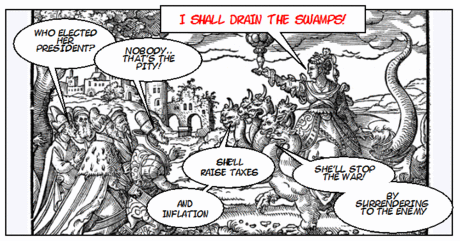
As mentioned on this site, Leadership is one of the Five Horsemen of the Investment Apocalypse. And this allusion to the Book of Revelation and the End of Days reminds us of the above old engraving of Mystery, Babylon the Great, the Mother of Harlots and Abominations of the Earth.
The ascension of Nancy Pelosi to the presidency of the United States could have the gravest consequences for the country and the world.
Here is what we know:
Since 1987, Nancy Pelosi has served as a representative of one of the most liberal districts in the United States, the 8th district that includes the San Francisco area. Daughter of a Democratic politician and wife of a multi-millionaire, she is the supreme political back-room operative — a perpetually reelected incumbent who has never had to face a credible opponent because Republicans are only 13 percent of registered voters in her district. She first gained her seat due to insider’s access to an off-election, and has being continuously re-elected with the help of her husband’s millions and a docile left-wing electorate in a gerrymandered district.
Her father was a Democratic congressman from Maryland (1939-47) and a former mayor of Baltimore. Her brother was named after Franklyn Delano Roosevelt. To gain political office, she never has had to make political compromises with anyone not on the far left fringe of America politics. As President, she would have no reason or inclination to represent all the American people.
Nancy Pelosi has never served in the military and opposes the War on Terror. She has advocated withdrawal of U.S. forces from Iraq by December 2006. She voted against consideration of appropriations for intelligence and intelligence-related activities in fiscal year 2007. She voted against adoption of the recommendations of the 9/11 Commission. She has said that electronic surveillance of terrorists is illegal. She voted against reauthorization of the Patriot Act.
Nancy Pelosi has no significant executive experience and would be entirely unprepared and unsuited for the responsibilities of the presidency. She has never been governor of a state, head of a corporation, military officer, or even mayor of a small city or town.
She is a profoundly divisive individual, with little sympathy for other points of view beyond the world of extreme left-wing politics. Anticipating her ascension as Speaker of the House, she speaks of “draining the swamps” — meaning that she will use her ‘mandate’ of 0.06% of the American electorate to ride rough-shod over the majority of Americans. She is not a ‘healer’.
Nancy Pelosi has already announced that she is in favor of market intervention: raising taxes, raising the minimum wage, fixing prices on pharmaceuticals, and subsidizing student loans.
As a representative from San Francisco, she is an ardent advocate of homosexuals and pedophiles (unless they are Republicans), refusing to vote with the majority to censure her friend, Representative Barney Frank for having engaged a male prostitute who he later hired as a personal assistant. She urged President Clinton to resign as honorary head of the Boy Scouts because of that organization’s policies protecting children against pedophiles.
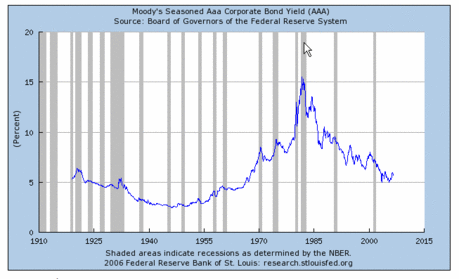
Nancy Pelosi has announced that she opposes trade with any country that does not enforce ‘core labor principles’ that grant wages and benefits to their workers equivalent to those in the US. She will impose sanctions on US companies that contract production offshore. Following the example of Richard Gephardt, she favors measures to eliminate the trade deficit. (See: “Trade Deficits Have Depressed Bond Yields for 20 Years“.)
This then is what we have to expect from the woman who may any day now become the leader of the Free World!
How Nancy Pelosi Could Effect The Flow of Funds
It is not too difficult to foresee what President Pelosi’s policies might mean for the American economy and the world.
As President, with enough time remaining in her term, with the help of left-wing Republicans in the Senate and a majority in the House, she could do immense damage.
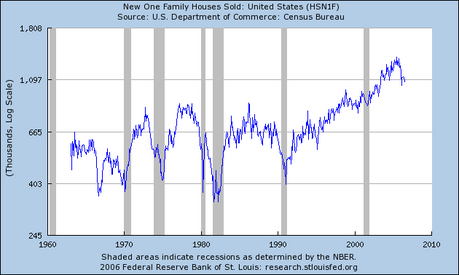
Measures to reduce the trade deficit, such as the 1988 Omnibus Trade and Competitiveness Act, would dry up this vital source of funds for the bond market. Interest rates would soar. Housing and the stock market would collapse. The fall in security prices would implode pension plans.
Cutting off importation of inexpensive goods from abroad would increase the cost of living, reduce traffic in the malls, and put millions in retailing, transportation, and port facilities out of work.
Increasing taxes would discourage entrepreneurial activity, which would feed unemployment and decrease government revenues, increasing the fiscal deficit.
Withdrawal of American troops from Iraq and a retreat from the War on Terror would destroy the credibility of the US abroad. This could lead to a successful attack on a major US city. A foreign policy based on appeasement as Nancy Pelosi proposes would simply hasten the day when terrorists have an atomic bomb that, with weakened national security, may be transported to New York or San Francisco.
A successful atomic explosion on a major US city would, as history has shown repeatedly, turn a peacenik US president into an Angel of Vengeance. Nancy Pelosi, who values the reelection of the Democratic Party over all things — especially over a few million foreigners who might be ‘collateral damage’ — (if still President when this happens) would wage atomic havoc and let loose the dogs of war on North Korea, Iran, Iraq, and any other convenient target.
Get Out Your Prayer Rugs
Now, I’m sure that Nancy Pelosi is really a ‘fun person’ and great mother for her children and loyal friend of people like Cindy Sheehan and Michael Moore, but really … is she the right person for the job of US President?
So, for those readers in the Middle East who might look hopefully upon President Pelosi for a victory against the Great Satan, I would say, think again. Get out your prayer rugs and pray to Allah that she never becomes president. Remember, 99.9% of all those killed in American wars in the 20th century perished under Democratic presidents who didn’t blink at incinerating civilians. Remember: Hiroshima, Nagasaki (Truman), and Dresden, Hamburg (Roosevelt).
To those in America who say it doesn’t really matter who wins the US election on November 7 2006, I would also say, think again.
 |
|
 | 3 Comments »